Materials
Choosing Watercolor Paper
Choose watercolor paper by fiber, weight and surface: cotton against wood pulp, 140 lb against 300 lb, cold press, hot press and rough, sizing and stretching.
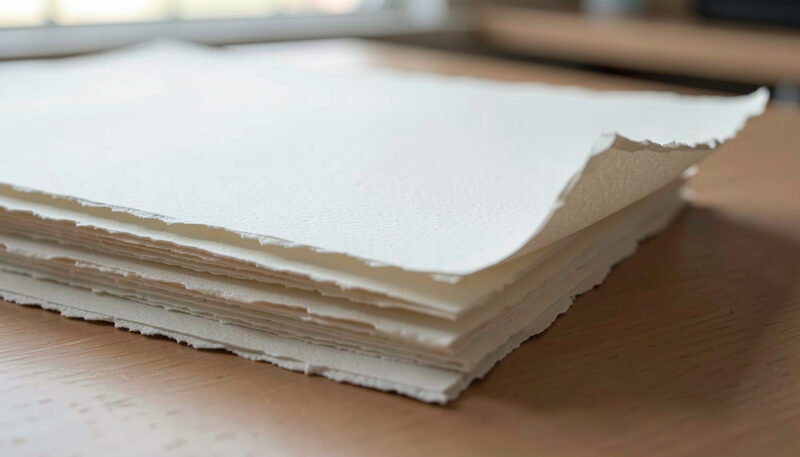
Paper is the most important purchase a watercolor painter makes, and the one beginners most often get wrong. Paint and brushes can be replaced without much loss, but the paper decides how the water behaves, how the color dries, and whether the finished painting survives the years. A good sheet will forgive a clumsy wash; a poor one will fight every stroke. This guide explains the three things that matter, fiber, weight and surface, and how to choose among them.
Why paper matters more than paint
Watercolor paper is sized, that is, treated so that it resists water to a controlled degree. That sizing, together with the fiber, sets the working time. On well-sized cotton paper a wash stays open long enough to be manipulated; on cheap paper it dries almost at once and leaves hard edges everywhere. The paper also decides the brightness of the finished picture, because in watercolor the white of the paper is the light. Cotton stays bright; wood pulp slowly yellows and takes the light with it.
Fiber: cotton against wood pulp
Cotton paper, sometimes labeled 100 percent rag, is made from cotton fiber and is the standard for serious work. It is strong, it absorbs water evenly, it tolerates lifting and scrubbing, and it does not yellow. Wood pulp paper, often called student or cellulose paper, is cheaper and lighter. It buckles more, it lifts poorly and it ages badly. A blended paper sits between the two. For learning technique, cotton is worth the price, because a beginner needs a surface that behaves predictably.
Weight and why it matters
Weight is given in pounds, as in 140 lb, or in grams per square meter, as in 300 gsm. Heavier paper holds more water before it swells, so it buckles less and allows wetter washes. A 140 lb sheet is the common choice for everyday work, and it needs stretching or taping for a very wet painting. A 300 lb sheet can be painted without stretching and lies flat, at a higher cost. Lightweight paper, around 90 lb, is fine for sketches and studies but is not suited to a large wet wash.
Surface: cold press, hot press, rough
Surface is the texture of the sheet. Cold press has a moderate grain, which is the all-round choice and the most common. Hot press is smooth, and it suits fine detail, pen work and botanical studies, but it shows every hard edge. Rough has a pronounced tooth, which gives sparkle to dry brush and texture to stone and foliage, and which is harder to use for small, precise shapes. A painter soon learns which surface suits their subjects; many keep all three.
Sizing and how it changes the paint
Sizing can be added to the pulp, called internal sizing, or applied to the surface, called external sizing. A hard-sized sheet lets the paint sit on the surface and stay workable, which is good for glazing and for lifting. A soft-sized sheet drinks the paint and dries fast, which suits loose, direct work. Some sheets are labeled as containing no animal products, which means the sizing is synthetic. The difference is felt on the first wash.
Stretching, taping and blocks
To keep a light sheet flat, it can be soaked and stretched on a board, or taped on all four sides with gummed tape so that it dries taut. A watercolor block, a pad glued on all four edges, does the same job and is convenient outdoors; the finished sheet is cut free with a knife along the glued edge. Whichever method is used, the goal is the same: a flat surface that does not ripple when water is applied.
How to test a new paper
Before committing a large painting to a new paper, test it on a corner. Lay a wet wash and watch how long it stays workable, then lift a little of it with a clean brush to see whether the paper releases the color or holds it. Scratch a small dry-brush mark to judge the tooth. Glaze a thin layer over a dry one and check that the first layer does not lift. A few minutes of testing tells the painter more than the label, and it prevents the disappointment of a painting ruined by an unfamiliar sheet. Keep a note of the results with the sketchbook, because papers vary by brand and even by batch.
Storage and handling
Watercolor paper should be stored flat, in a dry place, away from light and dust. Loose sheets are best kept between two boards or in a portfolio, so the corners stay sharp and the surface is not dented. Blocks and pads should be kept closed to protect the glued edges and the surface. Finished paintings are stored flat, interleaved with acid-free tissue, and framed behind glass with a mat so that the paper never touches the glazing. Handled this way, cotton paper keeps its brightness for decades.
Choosing for the subject
For a loose landscape, a cold press or rough cotton sheet of 140 lb or more, taped or blocked, is a reliable choice. For botanical work or architecture, a hot press sheet gives the smooth surface that fine edges need. For sketches and color studies, a small cotton block is ideal because it can be carried and painted on the spot. Buy paper in the size and surface actually used, and keep a few sheets of a heavier weight for the paintings that deserve them. The materials section sets paper beside brushes and pigments, and the technique guides show how a good sheet behaves under a wash.