Painting Subjects
Painting Water in Watercolor
Paint still water, moving water and reflections in watercolor: reading the surface, keeping reflections simple, edges and ripples, and reserving the light.
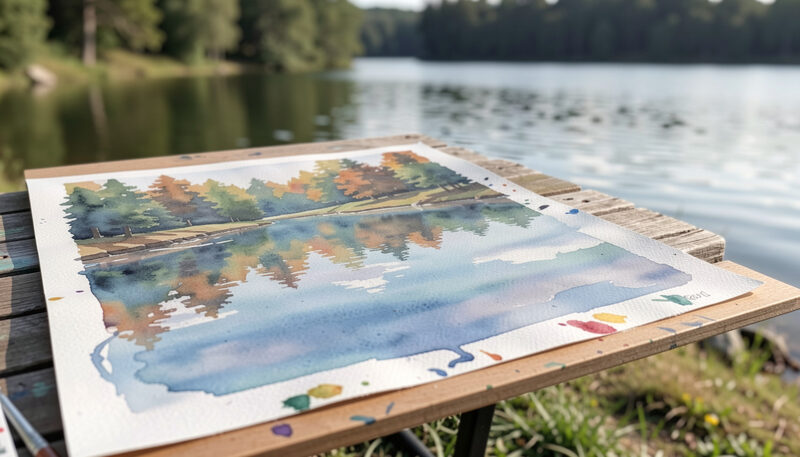
Water is a mirror, a surface and a color all at once, and it is one of the most rewarding things to paint in watercolor because the medium already behaves like the subject. Still water reflects the sky and the shore; moving water breaks the reflection into ripples and glints of light. The painter's task is to decide what kind of water it is, to reserve the light, and to keep the reflections simple.
What water does to a painting
Water anchors a landscape and gives it depth, because it lies flat and reflects the sky above. It also provides the brightest notes in a painting, the glints and ripples that are usually left as bare paper. Because watercolor is transparent, the painter builds water by painting the darks around the lights, exactly as the eye reads a reflective surface. The white of the paper becomes the shine on the water.
Still water and reflections
Still water, in a lake or a canal, reflects its surroundings in horizontal bands. The reflection is darker than the sky it reflects, less detailed than the shore, and broken by slight movement. Paint the reflection in simple horizontal shapes, darker and cooler than the sky, and leave the lightest ripples as paper. The reflection of a tree is a soft vertical smear, not a drawn tree; the reflection of a cloud is a pale band. Keep it loose, and resist the urge to add detail, because detail kills the illusion of water.
Moving water and ripples
Moving water, in a stream or over a weir, is painted as a pattern of light and dark shapes, not as a smooth surface. The dark shapes are the shadows between ripples, and the light shapes are the foam and the glint of the sun. Work from the darks to the lights: lay the darker water first, then reserve or lift the highlights. A dry brush stroke can suggest the sparkle of fast water over stones. The direction of the strokes should follow the flow of the water.
Edges and horizontal strokes
Water sits flat, so its strokes are almost always horizontal, even when the landscape above is built from vertical and diagonal shapes. Keeping the water strokes horizontal makes the surface read as level. The edge between water and land is usually soft and broken, not a hard line, because plants and stones interrupt it. A hard horizontal line across the water is one of the commonest mistakes, and it flattens the picture.
Reserving the highlights
The brightest parts of water are left as bare paper. Before painting, decide where the sun glints and where the foam lies, and protect those areas by painting around them. If a highlight is lost, it can sometimes be lifted while the paint is damp, or recovered later with a damp brush or a little opaque white, though the reserved paper always looks more luminous. Planning the lights is the single most important step in painting water.
The color of water
Water has almost no color of its own; it takes the color of what it reflects and what lies beneath. Deep water reads as a dark, cool blue or green, shallow water as a warm brown or gray from the bed below. On an overcast day water is gray and soft; at sunset it carries the warm colors of the sky. Because the color comes from the reflection, the water and the sky should be painted with the same family of colors, the water a little darker and less saturated.
Sea and breaking waves
The sea is painted like a moving surface on a large scale. The far water is a flat band of the sky color, darker than the sky, with a soft edge. Nearer, the water gains color and the strokes grow larger. A breaking wave is a dark, curved shape with a bright line of foam along its crest and a scatter of white where it falls. The foam is reserved as paper and then broken with a few faint strokes so it does not look like a solid white shape. Spray and distant whitecaps are left as small marks of paper, never painted with white, so that the light stays clean.
A worked reflection
To paint a simple reflection, first lay the water as a flat band of the sky color, slightly darker and cooler than the sky itself, and let it dry. Then, for the reflection of the far shore, use the same colors as the shore but weaker and less defined, and place them as short horizontal strokes in the lower part of the water. Break the strokes with small gaps so the reflection seems to move. Finally, lift or reserve a few light marks for the glint of the sun, following the direction of the ripples. The reflection should sit below the far bank, darker nearer the viewer, and it should never be as sharp as the land it reflects.
Reflections of sky against shore
A reflection is the sky color in the upper part and the shore color in the lower, split by the horizontal line where the far bank meets the water. The nearer the reflection is to the viewer, the more it is broken by ripples and the darker it becomes. Painting the sky reflection first, then adding the broken shore reflection over it while the first is still damp, gives the soft, joined look of real water. As with the sky, the key is to keep it simple and to trust the paper. The sky guide and the subject section show how the two subjects fit together in one landscape.